
I built a panel gauge recently for the Hand Tool School and used X-acto blades for the knife. It works ok but I’m not happy with how slight the marking line is. I like a beefier blade with a single bevel. That more pronounced bevel creates a larger V cut in the wood making the line easy to see but also guiding the saw or chisel more effectively. Technically the single bevel is more accurate as well since you reference the flat edge toward the “keep” face of your board. This is splitting hairs because the bevel on an X-acto blade is very slight.
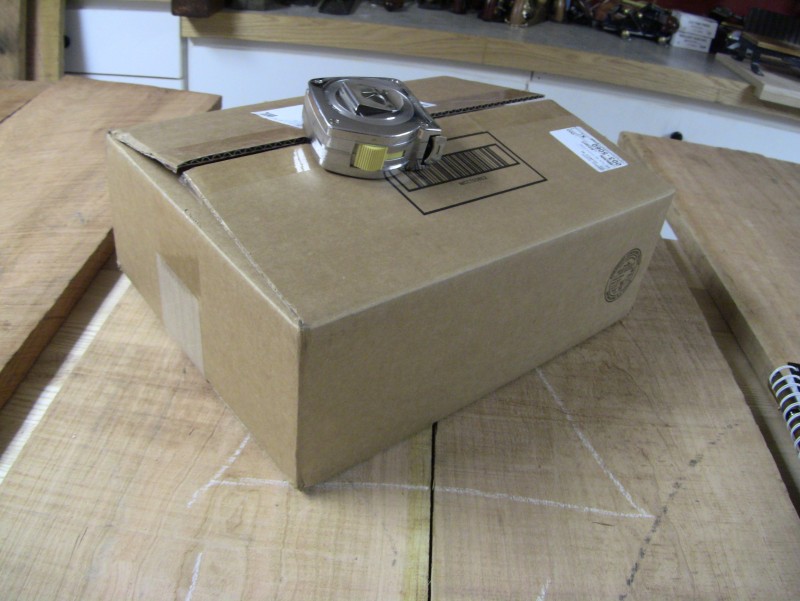
In my search for a better blade, I could have purchased a replacement blade from any of the many tool makers that sell cutting gauges these days. However, I wanted to take this opportunity to make my own blade and play around with some tool steel. Enter, everyone’s favorite raw parts dealer, McMaster Carr. They sent me this box the other day and I was shocked by the size.
I opened the box and sifted through mountains of paper and peanuts to find this tiny strip of 1/8 x 1/4 x 18, O1 tool steel.
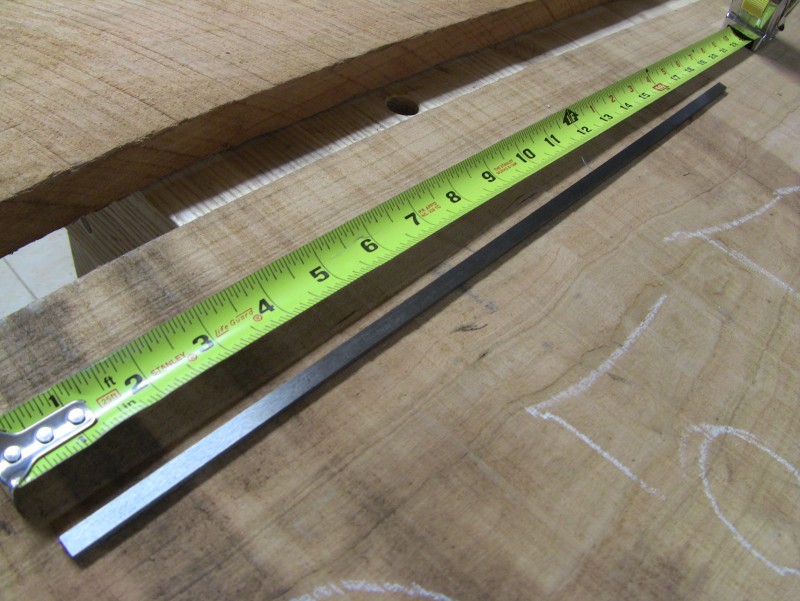
I guess they really wanted to make sure it got to me undamaged! So now I am presented with the task of learning how to work with this stuff. Obviously as a woodworker I know how to grind on a bevel and hone the edge, but I now have to cut this bar into the right length. So how do you cut O1 steel? I don’t want to draw out the temper by doing it the wrong way. I could also look it up, but what is more fun than engaging my audience for expert advice. So how would you cut the steel to length? Do I need to bake the steel to harden it later before I grind the bevel?


Is the tool steel already hardened? I would guess that the steel is soft and that will allow you to work it easily – grind the rough bevel and cut it to length with a hacksaw. Then you would have to harden and temper the blade and finish the bevel as metal tends to warp a little when hardening.
Chris
I am assuming that it is not hardened too. I have not tried cutting it yet with my hacksaw, but I suppose if it won’t cut then I’ll have my answer.
Shannon, I use a hacksaw to cut 01 steel. You can grind your profile first without worry of bluing since you’re going to heat treat it anyhow. Don’t grind all the way, though. Leave some beefiness at the cutting edge to grind away after the heat treating.
Shannon, O-1 can be cut with any good-quality hacksaw blade. If you want to burn electrons, a cut-off disk in a Dremel tool works too.
Cheers — Larry
When you dunk it in the oil, make sure you’re gripping the end of the blade in a set of channel locks that are angled away from it, so your hands are out of the way. It will flare up and may burn you otherwise. Also, be sure to dunk the blade straight down into the oil so all parts are cooled at the same timie. Keep the blade moving back and forth in the oil so no bubbles stick to the surface of the blade.
What is your heat treating technique? I have some notes from Adam Cherubini’s presentation at WIA that talks about putting in an oven at 400 degrees for a few hours. What about you? Any specific kind of oil work best? Here is the other issue, the finished blade will only be about 1 inch long. Would you recommend leaving it a bit long for easier grinding then trimming after heat treating, quenching, and honing?
Shannon,
Use a torch to harden the steel. For that small bit, a propane torch should work fine. Use the oven to temper the blade. Seeing as hardened steel is so hard to work (read: slow), I would cut it to final length first. Or you could experiment cutting almost all the way through before hardening, then breaking it off afterwards.
Chris
Shannon,
Good information above. I make knives for cutting gauges from worn out jig saw blades. Just grind off the teeth. They are hard already.I use the throw away blades from my plane to make marking knives, Just grind off the bevels and grind in a tang. Hacksaw blades also work.
Mike
I use peanut oil because it smells better than motor oil. I use a mapp and propane torch for plane blades so both sides can be heated at the same time. I go for a bright orange-yellow, dunk, cool, sand off the black gunk, stick it in the oven for an hour at 350. You need to sand off the black stuff so you can see when the blade changes color to straw yellow. Leave the blank long, grind it, heat treat, do your final grinding and honing, then cut to length. Safer that way. You can do a search on my blog for the heat treating method I use if you like.
I’ve actually been considering buying some W1 steel for making some marking gauges, and found this site very helpful:
http://tidewaterblacksmiths.net/2.html
This one too:
http://www.navaching.com/forge/heattreat.html
The consensus seems to be heat it up until it’s no longer magnetic, but don’t overheat it. Dunk it fast, and keep it moving while you dunk (only dunk for a couple seconds, until the color is gone from the steel). Let it air cool for about 15 minutes, and then stick it in an oven set at the appropriate temperature to temper it to the desired hardness.
The steel is most definitely not hardened out of the box from McMaster/Carr – I believe the O1 is around B91-95 (their website says Brinell 190-210).
I’m looking at the W1 since it’s safer to quench (no flammable oils) and is plenty hard for marking gauge blades.
Thanks for the links Jimi and thanks to everyone who responded. This is great information. I know I was being a bit lazy and I could have just Google’d it to get some of this, but the social proof and personal experience that I just learned from the community is so much more powerful. Thank you all
Ron Hock covers this topic well in his book The Perfect Edge. I would suggest it as a great reference and how to for anyone heat treating their own tools and blades. It also has the bonus of including a lot of other interesting and useful information.
Great suggestion Tom. I have leafed through that book but never bought it because I already have several sharpening books. It has been on my list for a bit but I haven’t pulled the trigger. Sounds like I have the push I need now.
Didn’t Bob Rozaieski go over this a couple of podcast episodes ago?
Shannon,
Strangly enough i just recieved the latest Shopnotes and it covers the whole process.
Tyler
Make sure you quench it in a large quantity of oil. Too small and it will go on fire!