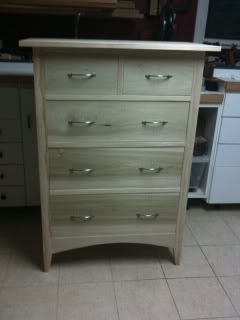
Sorry to hear about your dilema there Shannon. Because it’s a commission, I would likely try to strip as much of the old finish off as I could and try again, but that’s just me.
One suggestion I have is regarding the type of paint. I’ve never had a lot of luck using standard household latex paint for furniture. It’s too thick, making a piece look fake and plastic like and doesn’t have any real character since it sits on top of the wood in a thick rubbery film. To me it makes fine furniture look like a wall. The only time I use it on furniture now is for built-in type pieces where the piece has to match other painted trim in the room.
Instead, might I suggest milk paint. It is fantastic to use, easy to apply, actually soaks into the wood, unlike latex, and has fantastic subtle color variations and character when the finish is done. I typically do two coats of milk paint, sanding lightly in between coats as it will raise the grain. I finish with BLO over top. The finish is beautiful when done and actually gets better and more charismatic as the piece ages. You don’t need to prime first either as it works best on raw wood.
I think I’ve got an electronic copy of an old article by Mike Dunbar on using it if you’re interested. Shoot me an email and I’ll send it to you if you want.
Yes I would love to see that article. I guess this is not accurate but I always think of milk paint like a wash coat that is very dull. I had not thought about top coating it like you do with BLO. Short sighted I realize now. For this piece the customer wants a glossy appearance so I suppose I could use the Arm R Seal I have on hand to top coat the milk paint. Do you have a brand up milk paint you recommend?
The Arm R Seal would probably work or you could also shellac over top of the milk paint for a gloss finish and then simply rub it out to the gloss you want. Traditionally you would use pumice and rottenstone with water and or mineral oil as a lubricant to rub to a high gloss but I’ve seen really nice smooth high gloss finishes done with automotive compounds as well. I think you start with a rubbing compound, progress to a polishing compound and finish to a high gloss with a finishing polish. For the milk paint I’ve only used paint from the Old Fashioned Milk Paint Co., however, the Real Milk Paint Co. has been highly recommended to me as well. Let me see if I can dig up the article and I’ll send it to you.
I’m probably too late to be of help on this project, (I’ve been so busy as of late, I fell behind in my blog reading) but maybe my suggestions will help on the next one. If you are using latex paint, add floetrol to the base. It makes the paint dry more slowly, thereby leaving less brush marks. Also, several light coats with a foam roller will leave a smoother finish than a brush. For oil base, you can add penetrol which acts as a conditioner and has the same slowing effect. Milk paint is another alternative, however it has characteristics that are completely different. You’ll have to experiment to see which products you like the best.
Beth, great tips. I have heard of both of these products before but never used them. Normally I has just used water to thin my paint and in this case just didn’t thin it enough for this new brand. I just bought some Milk paint this week and hope to try it out on my next painted project.
Thanks to everyone who made it out for The Hand Tool School live session. What did you think of the @spreecast platform for Q&A? 12 hours ago
Hand Tool School Live Session tonight at 8 EDT, http://t.co/ngz7w3CHTt I'm leaving the topic to open Q&A, all are welcome. Got a question? 17 hours ago
Shannon, I’m sorry to hear about the finishing problem. What a shame, after you spent so much time on the chest of drawers (and handcut dovetails).
Instead of sanding, can you use a paint remover? I think there’s actually a product called Orange Peel.
Sorry to hear about your dilema there Shannon. Because it’s a commission, I would likely try to strip as much of the old finish off as I could and try again, but that’s just me.
One suggestion I have is regarding the type of paint. I’ve never had a lot of luck using standard household latex paint for furniture. It’s too thick, making a piece look fake and plastic like and doesn’t have any real character since it sits on top of the wood in a thick rubbery film. To me it makes fine furniture look like a wall. The only time I use it on furniture now is for built-in type pieces where the piece has to match other painted trim in the room.
Instead, might I suggest milk paint. It is fantastic to use, easy to apply, actually soaks into the wood, unlike latex, and has fantastic subtle color variations and character when the finish is done. I typically do two coats of milk paint, sanding lightly in between coats as it will raise the grain. I finish with BLO over top. The finish is beautiful when done and actually gets better and more charismatic as the piece ages. You don’t need to prime first either as it works best on raw wood.
I think I’ve got an electronic copy of an old article by Mike Dunbar on using it if you’re interested. Shoot me an email and I’ll send it to you if you want.
Good Luck!
Bob
Bob
Yes I would love to see that article. I guess this is not accurate but I always think of milk paint like a wash coat that is very dull. I had not thought about top coating it like you do with BLO. Short sighted I realize now. For this piece the customer wants a glossy appearance so I suppose I could use the Arm R Seal I have on hand to top coat the milk paint. Do you have a brand up milk paint you recommend?
Shannon
Shannon,
The Arm R Seal would probably work or you could also shellac over top of the milk paint for a gloss finish and then simply rub it out to the gloss you want. Traditionally you would use pumice and rottenstone with water and or mineral oil as a lubricant to rub to a high gloss but I’ve seen really nice smooth high gloss finishes done with automotive compounds as well. I think you start with a rubbing compound, progress to a polishing compound and finish to a high gloss with a finishing polish. For the milk paint I’ve only used paint from the Old Fashioned Milk Paint Co., however, the Real Milk Paint Co. has been highly recommended to me as well. Let me see if I can dig up the article and I’ll send it to you.
Bob
I’m probably too late to be of help on this project, (I’ve been so busy as of late, I fell behind in my blog reading) but maybe my suggestions will help on the next one. If you are using latex paint, add floetrol to the base. It makes the paint dry more slowly, thereby leaving less brush marks. Also, several light coats with a foam roller will leave a smoother finish than a brush. For oil base, you can add penetrol which acts as a conditioner and has the same slowing effect. Milk paint is another alternative, however it has characteristics that are completely different. You’ll have to experiment to see which products you like the best.
Beth, great tips. I have heard of both of these products before but never used them. Normally I has just used water to thin my paint and in this case just didn’t thin it enough for this new brand. I just bought some Milk paint this week and hope to try it out on my next painted project.