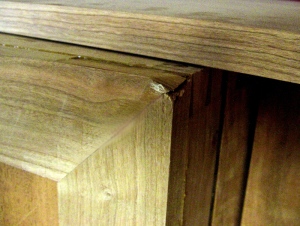
Sorry about the title, still riding high after going to see The Avengers. I need some advice from my virtual woodworking guild. (if you’re reading this, you’re in) I have been working on a tool cabinet for an embarrassingly long time. I am proof positive that multi-tasking doesn’t exist as other projects get in the way and the tiny amount of work that is left to be done on this cabinet stretches into months and months. So when I had a few minutes while waiting for finish to dry and Hand Tool School videos to render, I started to hang the clam shell doors on the tool cabinet. I set one door aside to layout the hinge location on the other door. Stupidly I stood the door on end. This would normally have been fine as the door is 3″ deep and quite stable…until I backed into it and it cartwheeled off my bench. Murphy’s law says that falling furniture projects will always land on the most fragile and most visible point. In this case the front top corner right where the miter half lap comes to a point.
Assume fetal position and turn on your Morrissey records.
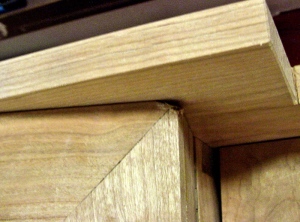
I realize this is “just” a tool cabinet and it will probably get banged up anyway. It already has a few shop scars since I have essentially been using it to store tools in it’s quasi finished state (another sure fire way to never finish a project is to begin using it before it is done) I have worked hard on this cabinet and want it to look it’s best so anybody out there has a fix for a crushed corner? I can certainly clean it up a bit with a chisel but it will eventually end up looking rounded over and not crisp like the other corners. This will make it stick out like a sore thumb, especially to me. To make matters worse, this corner is at the top where it meets the flat plane of the top and the deviation will show up even more.
Google+ ProfileHelp? Anyone got an idea to restore this corner?


I might try the burnishing technique that WIlliam Ng talks about in one of his videos where he is trying to fix a gappy long mitre joint. http://wnwoodworkingschool.com/fixing-a-not-so-perfect-mitered-joint/ It depends on how fragile the crushed fibers are, but the glue would likely soften them and make them pliable enough to bend rather than break as you try to massage them back into place.
Best ofluck!
Two ideas, neither of which I *KNOW* will work, but food for though nonetheless, and a third, sure fire one:
1. harness the awesome power of boiling water to swell the wood, it may bounce back to some degree (some do this for dents using a damp cloth and an iron, but in this case, submerging for a few seconds may do the trick) when it’s pliable, you might be able to coax it back to close to the original shape. Some well placed CA glue to re-attach any splintered bits, and you’re good to go (maybe)
2. On-the-fly design change: rip an 1/8th inch (or whatever width is enough to remove the blemish) off all four sides of both doors and apply a mitered cockbead (in your choice of species, contrast or match) around the perimeter. Just like you meant to do that.
3. Do Nothing: Leave it there to remind you never to do such a silly thing again. (well, this has never *actually* worked for me, but it should, in principle)
You might try steaming it or soaking the corner in hot water. The fibers might expand back out and reduce the damage. At that point, you could do as James suggests and work in some glue or glue/sawdust, or even, dare I say it, wood putty to fill any gaps.
However, if you think it’s really going to bother you, it might be best just to disassemble the door and replace the parts. You picked up a little extra lumber when you started this project just in case, right?
Good luck.
Pare off enough of the corner so that you can glue on a contrasting piece of wood, then plane/chisel/rasp it so that you have a clean corner again. Then apply the same treatment to the other corners or to the other doors so that it looks symmetric to you. Instant design element.
Cut 45 degree chamfer all around door. ( maybe 1/4 inch. Make Matching pieces out of contrasting wood, glue them on and trim to create stunning decorative touch. Cock bead idea is good also.
Ron
A burnt sacrifice is the only option.
Thanks for all the great thoughts, this mirrors a lot of what I was thinking. I really like the clean mitered corner in this and specifically chose straight grained cherry so I wouldn’t distract from the bookmatched quartersawn Mahogany panels. So I’m hesitant to add a contrasting strip or even a cockbead. The steaming idea was my first thought and combined with the William Ng burnishing technique (great video reco James!) I think I can shape it back to something that will work. If that fails, a Cherry bead might work as long as it is understated. I might then add a cockbead to the 9 drawers that make up the bottom of the cabinet to echo that element. Much to ponder.
Shannon,
Could you rotate the door so the dent is at the bottom left corner instead? Or carve it away and make it into a finger grip with which to open the door?
Chris
Chris, I can always count on you for a fresh idea. I really don’t like the look of the bookmatched panels in any other orientation and the dent is on the hinge side. I love the suggestion though.
Oh come on you guys….this is clearly an opportunity for a parenting moment.
You obviously need to apply an Avengers band-aid, maybe two. This will have two effects…it will make the cabinet feel better and make it the envy of all the other “children”. Win-win.
And if one of your friends/viewers asks about it, just roll your eyes and say “you know what kids are like”. Just don’t give in to all the other “kids” wanting their own band-aids…it will escalate and pretty soon you’ll be installing dutchmen everywhere!
Shannon,
I know exactly how you feel. I just stupidly applied some “shop rash” onto my hope chest project in a very prominent location, I am going to try the wet rag/iron treatment to see if I can expand the fibers a bit. I think the ding is too deep for a full fix though. You could just beat the whole thing up and give it the look of a hundred years of “patina”
Dave
Shannon -
I would try water/steam to expand the fibers. Depending on how it came out, I would then chamfer then entire outside of the door to disguise the flaw. I don’t think that would distract from the panels.
Good luck! Let us see how it turns out.
Jonathan
======================================
HA! I did the exact same thing with one of my clam shell doors on MY tool cabinet. Used the steam iron trick. It helped a little. It’s on the top of my door so unless you’re .. say 6′ “4″, you wouldn’t notice it.
Here’s a picture of mine after steam ironing. http://sheworkswood.files.wordpress.com/2012/01/dohdrop.png
Stand back view here: http://sheworkswood.com/2012/01/16/chocolate-walnut-and-maple-inside-with-a-cherry-outside/
Just plane a small 45 and taper it away from the miter then glue on a piece of matching cherry and then plane it back to square, do the same for the other side of the miter, if you match up the grain they will never see the repair.
Joe Ledington
The sure fix involves clean water, a god sleep, a trip to shrinks couch to realize… It’s still perfect. It’s still a great lesson for readers and you. It still works perfectly as designed. It perfectly emblazed into your brain what not to do. So just cut all
4 outside corners at a 45 and call it homage to battlestar gallactica.
I also vote for steam, but if steam alone does not swell the wood out enough, then letting it soak in boiling water for a while might be the best choice. What glue did you use? If you used the “right glue”, it will only reset when it cools. Otherwise this procedure might necetate reglueing the corner. it’s amazing what soaking the wood can do when steam is not enough. Make sure to give it ample time to dry afterwards as well before to try to sand/plane/scrape it smooth after.
Easy to fix – I have fixed dozens like it
Heat a clothes iron to its hottest setting. Place a slightly wet rag over the dent. Run the iron over it to form small steam pockets that will expand the fibres
Easy
It looks like too many torn fibers for the steaming trick to help enough. Building it back up with an epoxy or polyester resin, and then painting it to match might work, but that’s the only thing I can think of. Barring that, all I can offer is my sympathies – been there myself.
Shannon. After you decide what you want to do, why not video it so that the rest of us can see the result and hopefully benefit?
Silly John, don’t you know by now that the record button is hooked to the light switch in my shop?
Perhaps think about ploughing a rabbet on all four sides of the cabinet to the necessary depth/width and fill with something contrasty, like walnut…?
A lot of people have already said “steam it.” I suggest the same. Wet cloth, hot iron. Wash, rinse, repeat till done.
A ole boat builder (now gone) named “Dynamite” Payson used to say, “Wet it and rub a stick on it.” Pretty close to the same idea.
Silly me. Looking forward to seeing what you come up with.
Turn your liability into an asset .
Smash the other three corners and call it studio furniture.
Smiles
Don
Shannon,
You could kerf in a spline in all 4 corners so they match then plane the spline crisp to finish the 90 deg. corner and the top will sit flush. I know you were reluctant to use a contrasting wood, but it could become a design element.
Just a thought.
Anxious to see what you come up with ….I am sure this will happen to me eventually,
Brent
I say try the steaming first as you have nothing to loose but I would be real suprised if it works because I would assume the fibers broke upon impact. My first thought was a cockbead. How about an inlay? A vine or branch starting in the area of said collision leading across the top rail and down the stlie. Keep it small enough so it doesn’t overpower the design and add a nice accent.