
The woodworking world seems to be a flutter with talk of Nailed or Board Furniture. I’ll admit there is something exciting about quickly building a nice piece of furniture with little concern about complex joinery. More importantly, my wife really likes the idea too. So with the intent of giving the style a try I began to think about the tool kit needed for this straight forward style. It is startling just how few tools you need when it comes to a piece built entirely with dados, rabbets,grooves, and the occasional tongue & groove joint.
Let’s assume you are starting with already milled home center lumber. And why not seeing as most of this furniture was painted. I’ll also skip the sizing tools because whether you use a power tool or hand saw, these tools don’t differ much from a more complex style of furniture making. So you have your pieces sized and you are ready to begin joinery.
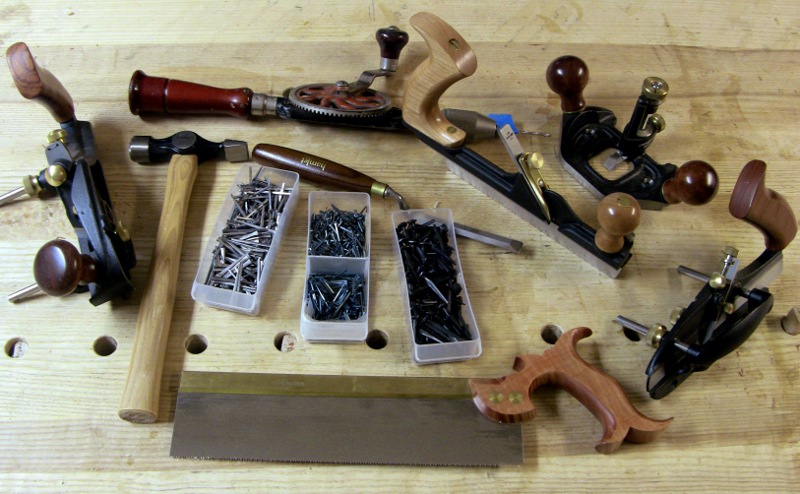
This is it. This style of furniture could be a great introduction for the woodworker looking to build a piece by hand because there are so few tools needed. This is a modern version of the tool kit as I have included several tools from modern makers like Lee Valley and Lie Nielsen. There are scores of cool wooden planes you could use instead of the modern more expensive counterparts.
This is also an all around tool kit that eschews dedicated tools for more utility tools. For instance, dados can be cut very quickly with a dedicated dado plane. The set width plane has nickers that score across the grain on both sides of the joint and will sink the dado very quickly with only one tool. My problem with this technique is that you need a separate plane for every new width of dado you cut. Not that you will be making many different sizes but just like plywood is never the same thickness, your joined boards may not all nicely fit into the fixed width that dado plane provides.
I prefer to cut dados with a saw, chisel, and router plane. I can scribe the profile of the joint off the board to be joined, saw the sides, whack out the waste with a chisel, and refine the depth with my router plane. That process can actually be even faster once you get the hang of it.
The remaining joinery is cut with dedicated but adjustable planes. Plow plane for grooves, Rabbet plane for rabbets, and Match Plane for Tongue and Grooves. Of these the T&G plane is not adjustable but it cuts the joint on a 1/2″ center which is great for relatively thin back boards where this joint will be used most.
As far as the nails themselves, these are installed first with the eggbeater drill to create the pilot but modern cordless drills work just fine here too. I most often use a standard fine finish cut nail but for more delicate parts, I will use a headless brad. Finally, when I want to show off my nails proudly I have wrought head nails that stand proud and add a rustic feel.
The above tool kit is very small, extremely quiet, and highly efficient. You never know, maybe even an extremely slow builder like me can produce furniture in a weekend this way.
Google+ Profile


This is very interesting. I would like to see you walk through a project.
Thanks!
It’s coming very soon Anthony, just looking for the right piece.
For what it’s worth, I’m one of the ones who’s so excited by what Adam brought to the table at WIA even though I wasn’t there. I’m a neophyte woodworker, and the idea of being able to put some pieces together quickly and simply has it’s appeal. I love mortise & tenon and dovetail joints as much as the next guy, but the ability to put something nice looking in the house while learning my way with those has a significant appeal.
Thanks for posting that tool kit. I have most of it already, and knowing that I can pick up the one piece I don’t have (tongue and groove plane) and crank out some stuff is truly wonderful.
Maybe we’re on the brink of a nailed furniture revolution!
Hey Shannon, would it be possible to make a plough/rebate plane using a chisel, keeping the tool box even smaller (and cheaper)?
Sure Martin, the chisel can make any of these joints. Planes are just chisels held at fixed angles after all. I have followed the same process I outline to make dados for both grooves and rabbets. In fact sawing the inside edge then splittling out the waste for a rabbet is lightening fast. I do find that having the plane around makes it easier to clean up the joint however. Paring can do it but it will be slower. If you are interested, the free preview I have of lesson one of my hand tool school shows how I make a long grain rabbet with only a chisel.
I agree with you on the dado’s. A rebate plane, saw, knife and chisel make quick work of it. I used that same method on my saw till and wall hanging tool chest though it wasn’t a nailed piece. One of my dado’s was a stopped dado which still works with these same multipurpose tools but it requires a little more knife and chisel work where the stopped part is.
Also, nickers don’t always leave clean edges (that probably depends on the wood) where I can always assure a clean, crisp edge with a knife and a chisel and then cutting the inside with a saw.
This is great! I find it quite reveling that your list of necessary planes are almost never the ones the forums recommend as the ones to start with.
Almost every post I’ve ever seen about what tools to start with include, smoothing plane, jointer and a jack/scrub.
Your list get people actually turning out furniture as opposed to just breaking down and preparing rough stock.
That is a great point Nik. Not often the kit that is suggested for people just getting started in woodworking, but probably a very good place to start.
Nik, I guess I should comment that some of those “first buy” tools will be nice to have too for finishing details, but the biggest thing to consider is stock selection. Either get your stuff planed at the lumber yard or be picky in what you buy from the home center so milling doesn’t have to happen. You can also design your piece around pre-dimensioned lumber.
Actually, you only NEED one dado plane (multiple sizes are nice, but far from necessary). In Nicholson’s discussion of the dado plane, he mentions the size 3/8″ only. You can make a variety of dado sizes from 3/8″ wide and up with this plane simply by moving the batten and planing multiple dados right next to each other. Need a 3/4″ dado? Nail on the batten, plane a 3/8″ dado, move the batten over 3/8″, plane another dado right next to it. How about 7/8″? Plane two 3/8″ dados and leave 1/8″ between to be knocked out with a chisel when the planing is done. It’s surprisingly fast. Like make a dado in just a few minutes fast. It also allows you to dado across multiple boards at the same time, say for two case sides. This ensures your dados line up with each other without all that math and measuring stuff. The saw chisel and router plane method is really slow comparatively.
Good perspective Bob. I really need to go read Nicholson again, AND find a good all purpose dado plane.
Hi Shannon,
Can you help identify the planes in the photo pls, clockwise from L to R:
LV Skew Rabbet
???
LV Router
LV Small Plow
Thanks, Eben
That is Lie Nielsen’s tongue and groove plane
Also, solving the need for multiple dado planes. Back in the day when dado planes were in more common use, the end of the board going into the dado would simply be rabbetted to fit into the dado. Top, bottom or both, your choice. With that methodology you can get away with one size dado, or if that idea makes you crazy, one narrower one and one wider one.