


New Miter Box Saw
Several months ago I bought a vintage Stanley miter box. It didn’t really need much work to clean up and get working which was just how I like it. A little rust removal and I replaced the bed with a clean piece of Poplar. The problem was the saw. I do intend to one day give it a complete makeover but my readers probably already know that I’m not a big fan of working on tools when I can be working with tools to build something else.
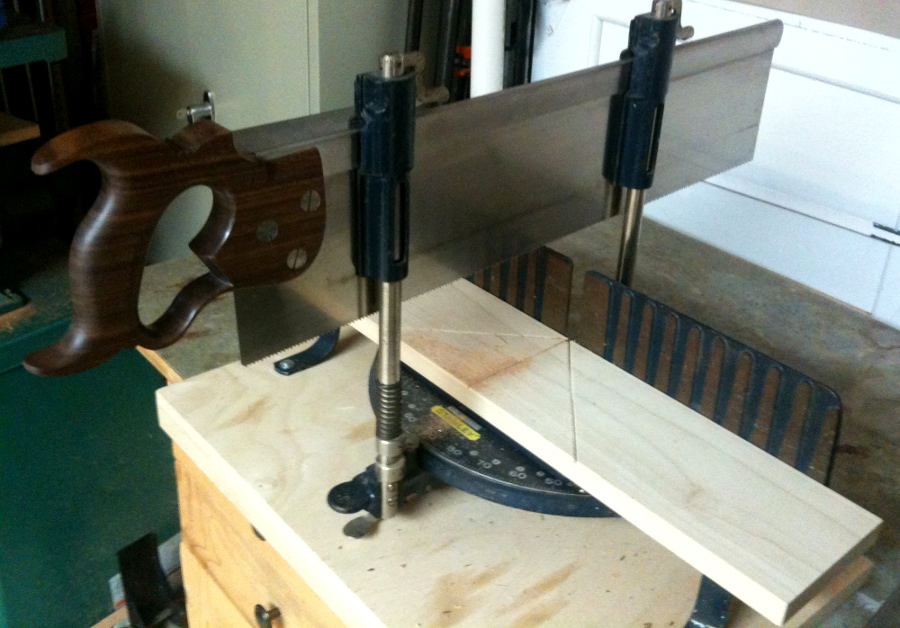 So when Mark Harrell of Bad Axe Toolworks told me he was going to start making miter box saws, I jumped at the opportunity. I may have a 3 year old iPhone but when it comes to woodworking tools I’m nothing but an early adopter. So beyond the honor of being the first and only owner of a Bad Axe Miter Saw, my vintage miter box is now a top performer that slices through wood with abandon. The cuts are dead accurate and clean and smooth. The accuracy relies mostly on the box itself since it guides the saw, but a poorly tuned saw makes cutting at the box a slog. Most miter saws have a higher pitch count so they produce a cleaner cut. In many instances they have a very relaxed rake so that they slide across the wood easily.
Mark has created a saw that balances the rake, fleam, and pitch equation perfectly so that it cuts very fast, accurately, and cleanly. However…
This saw is 20″ long as compared to the 24″ length of the vintage saw. I think I may have gotten used to the longer stroke of the old saw. While the new saw still cuts faster I keep pulling the toe of the Bad Axe saw out of the guides. My old saw had a 1/4″ hole drilled in the plate near the back that I put a bolt through. This prevented me from pulling the saw out of the guide.
The simple solution seems to be that I drill a hole in the plate of my new saw to insert the stop. I would rather put the stop bolt through the back as it would give me just a little more reach on the stroke plus the bolt will be run through a thicker piece and less likely to damage the saw plate when the bolt strikes the guides on a back stroke.
So it’s question time.
- For those of you that have a vintage miter box, what measures are in place to prevent the saw from pulling out of the guide posts?
- Does any one see an issue with drilling a hole through the back or the plate? Will I damage my new saw? (I have asked Mark this question too BTW)
Comment from Mark Harrell
“Shannon, FYI, I deliberately launched a 20″ miter saw specifically for the smaller boxes such as the Stanley No. 150 and the Millers Falls No. 200. Both of which have a significantly narrower span between the guide posts for the actual cut. In the Stanley 150’s case it has a metal sleeve that eliminates this limitation and allows for maximum cutting action with the 20″ saw. The same applies for the Millers Falls No. 200 only it’s a metal hoop frame rather than the Stanley sleeve concept. Both technologies work wonderfully well, and I like the ease of portability and compactness of both products.”
**Update 2/13/12**
I took the advice from the comments below and stuck rare earth magnets on both sides right at the toe of the saw. It worked great. The magnets don’t prevent the saw from pulling out but they offer a little resistance and a clear “clink” sound when they hit the box guide posts. That is enough for me to halt my stroke and to train my body where to stop. After cutting with these in place for 5 minutes the clinking went away as I had learned the optimal stroke just by listening. Whaddaya know that Pavlov guy was on to something!
