


Review of The New Traditional Woodworker
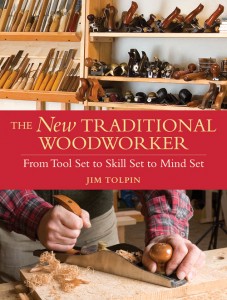
A good woodworking book makes you want to drop everything and head to the shop to try out what you just read. Jim Tolpin’s new book The New Traditional Woodworker
does just that…several times.
Click Here to Buy Your Own Copy
Anybody who has read any woodworking books knows who Jim Tolpin is. His power tool books could be considered to be text books. I remember being very inspired by Jim when I attended his design seminar at the 2009 Woodworking in America Design conference in St. Charles, IL. Here is a guy that after decades of running a professional cabinet shop, decided to give up the power tools and build furniture by hand entirely. I kept asking myself, “is this really the “Table Saw Magic” guy?”
When I created the Hand Tool School, I wanted to build a comprehensive course for woodworkers who wanted to work by hand. Along the way, the woodworker would learn many skills and apply them while building simple yet very useful shop appliances. So reading Tolpin’s book was an affirming experience as this is exactly the model he chooses. Hey if Jim Tolpin thinks this is the way to learn then who can argue right??
Within minutes of cracking the cover I was immersed in familiar exercises and instructions on flattening boards, squaring edges, and cutting joints. Let’s be honest with the exploding internet community most of this stuff is covered in forums and blogs so if you have paid attention there won’t be any new techniques. What you won’t find anywhere else are the little tips and methods of execution that only a craftsman of 30+ years can show you.
I consumed this book in a matter of hours. I actually read it cover to cover. The last time I did that was with “The Joiner and Cabinetmaker” and that was mostly a fictional story! Tolpin covers tools and what they do, but also how they do it. He attests that understanding some of physics behind a tool, the woodworker learns how to choose the right one for the job. There is also a lot about the mindset of the hand tool woodworker. This is particularly interesting again based on Tolpin’s extensive power tool background. Speed and process change, but also the motivation to build and the ability to derive simple pleasures from the sound of the plane. This style of woodworking becomes less about the deadlines and more about the process.
This is a modern take on hand tool usage. Tolpin has a shop that is stocked with old and new tools. I think this is an aspect that can be very inviting to many woodworking hand tool initiates. There are some brilliant masters out there who use nothing but vintage tools and time honored techniques with no gimmicks. Tolpin is hardly gimmicky, but he is not afraid to use a modern design if it makes his work more enjoyable. What’s more, Tolpin freely admits to having his lumber supplier plane his wood so that his work is lessened at the milling stage. He will still flatten his boards by hand, but once they have been skip planed his work is decidedly easier. I think this simple act alone is kind of a permission slip for the aspiring hand tool woodworker to buy a thickness planer and not worry about the smaller boards. I firmly believe that learning how to flatten and plane a parallel face by hand is a skill all woodworkers should possess, and I think Tolpin would agree with me. Frankly, once you know you can do it, why not save that skill when your tooling won’t help you like on that 20″ wide single board case side or table top. I found this refreshing that an accepted “expert” endorses this method.
The second part of the book is dedicated to small shop projects that will help build your skills. These are shop appliances that the new woodworker can feel okay about them not being of show quality. The project are helpful additions that will allow you to work more accurately and efficiently. Projects like winding sticks, a straight edge, bench hook, sticking board, and more. The one criticism I would have would be that throughout the book, there is a chicken and egg paradox where Tolpin illustrates the building of a project using the assistance of one of the projects later in the book. This is a small point and frankly if you are completely new to hand tool work, there are some things you just need to have to build others.
On the whole, one could really treat this book as a hand tool class. Follow the instructions and build the projects and you will learn fundamental skills that can help you build just about anything later on. Additionally, you would end up with many helpful shop appliances. This book is an exciting addition to Tolpin’s library and I think it perfectly illustrates his transformation from machining wood to working wood.
Right now Popular Woodworking is offering this book for only $17.81 as compared to the normal $26.99 retail. I highly recommend you pick up a copy today.
the links above are affiliate links that support this blog every time you use them
