


When Hand Tools Fail
I think one of the best ways to ensure hand tool success is to choose your wood species carefully. I received an email recently from a gentleman who was having trouble with blow out when using a chisel to make a stopped rabbet. During a video chat, I demonstrated how I do it and it went swimmingly. I was using Cherry and he was using some hard jungle wood. Some may say I was stacking the odds in my favor, but I call it good hand tool sense. The world of wood is enticing with so many beautiful exotics open to us, but tread carefully when you start to use some of these highly dense exotics. I don’t mean to suggest you can’t work hard tropical woods by hand, but in my opinion, it isn’t much fun. Really sharp tools are of course required like with any hand work, but you will have to visit the sharpening stones 4 to 5 times more often. There is really only one setting for your hand plane and that is fine. Trying to remove heavy shavings or chopping large pieces with a chisel is comparable to Sisyphus’ climb up the hill pushing his rock. This is where hand tools fail. When the hardness of the wood approaches steel and the density climbs towards the neutron star level, hand work is no longer fun.
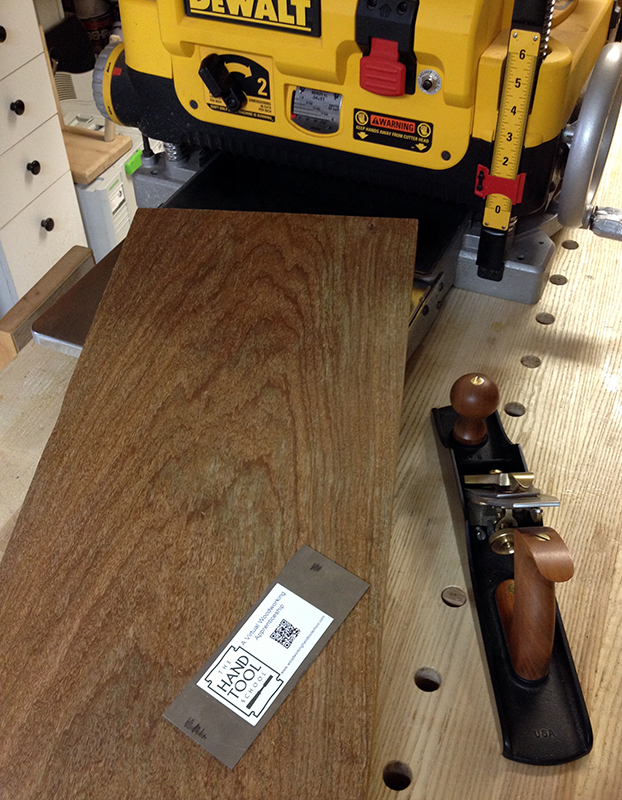 I was asked by a colleague at work to plane a sample piece of kiln dried Ipe today. Usually our Ipe is for decking purposes and is already S4S’d and in an air dried state. It was a single piece so I thought I would give it a try. A few minutes later he walks into my office and drops a hunk of Ipe 6/4 thick and 14 inches wide on my desk. I’m sure the seismometers in the area registered it when he dropped that piece. Ipe is very very dense and is 3 times harder than hard Maple and more than 5 times harder than my favorites Cherry and Walnut. It is diffuse porous and almost has no discernible growth ring because the density is so high. My planer only has a 13 inch capacity and the thought did cross my mind if only for second to surface the 24″ long board by hand. You know, for scientific purposes.
Needless to say, I would have had better luck trying to flatten my diamond lapping plate with my jointer plane. I took the board to my bandsaw and lopped off a few inches of the width then lugged out the thickness planer to finish the job. Planing a 12″ wide board with my Dewalt lunchbox planer puts a strain on the motor with most species and I rarely remove more than 1/16″ in one pass. With this in mind, I dialed back the thickness to 1/64″ on my first couple passes with this board. Once the rough sawn fuzz was gone and the knives began to bite across the whole board, the motor audibly struggled and I worried about popping the breaker so I dialed it back to 128″ passes. The motor recovered but you could still tell it wasn’t happy about what I was asking it to do. I should mention that the knives are brand new and the table was waxed too. After about 20 passes through the planer alternating sides I had removed just under 1/8″ and was ready to call it quits. I could tell that my blades were already dull and I had actually nicked at least one of them as I could see that tell tale raised line on the face of the board. I took a few more passes on each face with the planer set around 256″ in depth (basically 1/16th of a turn on the height wheel) then I removed the line from the nick using a card scraper. The finish is startling when Ipe is planed well but I’m starting to get a feel for what granite counter top makers deal with every day. I’m sure a more heavy duty planer would handle this better and a carbide helix head would help too. I know that the machines at our millworks eat this stuff up, but I think I’m done working with Ipe.
I think I’ll stick with Walnut and Cherry. When I’m feeling daring, I’ll use White Oak and Hard Maple.
