


Adjustable Dado Plane??
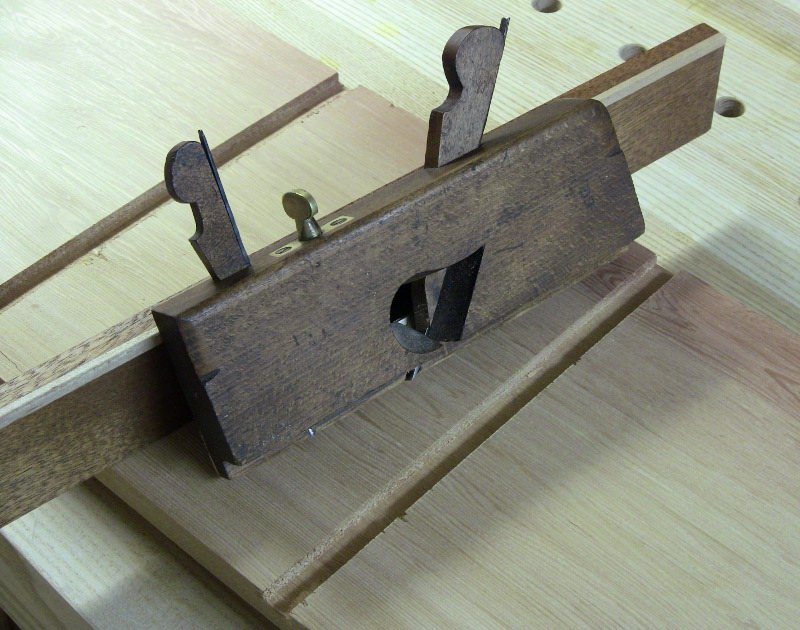 The dado is an essential joint in cabinetmaking. It can be cut many ways from table saw to hand saw. My favorite these days is a dado plane. Certainly a saw and chisel is all that is needed but setting a fence and just planing across the wood in a few quick strokes is really fast and incredibly satisfying. The problem with the dado plane is that it cuts only a set width based on the width of the blade. Unlike a tablesaw dado set where you can insert chippers and shims to change the dado, you get only one width of cut with a dado plane.
…Or do you…
When you prepare your stock by hand all kinds of random thicknesses will result. You quickly realize that our modern day 3/4″ standard is more work when starting with 4/4 stock and usually 7/8″ is more common. So you might think that buying a 7/8″ dado plane is the way to go. So what happens when you need to remove more wood on a troublesome board and you end up with a board that is 13/16″? Plus if you are working on a smaller cabinet like I am now, 7/8″ thick shelves looks clunky. 1/2 is probably too thin, but 5/8 looks just right. Suddenly you’re thinking, “how many dado planes do I need?”.
I suppose if you have an unlimited shop space and unlimited budget you could treat your dado planes like moulding planes and have 1 for every 16th of an inch. I think you would have to make them yourself first of all because the 18th century makers focused only on typical joinery sizes like 1/4, 3/8, 1/2, etc. Really just 1 or 2 dado planes is all you need. Maybe even just one will do, but it will need to be smaller than the narrowest dado you plan to cut. So the problem still remains, how do you cut a 5/8″ dado with say, a 1/2″ dado plane?
You adjust the width
“What? But you said dado planes have a fixed cutting width!”
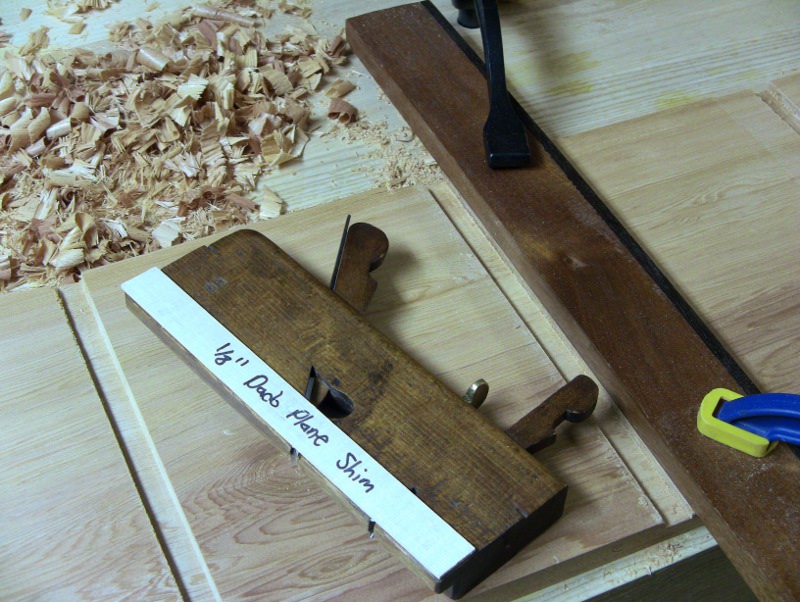 Enter magic tool (Sorry Rob, I couldn’t help it) #3,567. The mighty 1/8″ shim stock. Once I have cut the 1/2″ dado, I leave the fence where it is. Using double stick tape, I adhere the shim to the blind side of the dado plane. Now the cutting blade is bumped out from the fence by 1/8 and you make a second series of passes. Ta da! One 5/8″ dado!
What do you know, I guess I learned something from my power tool days after all. Shims make a dado stack wider. Conceivably you can create a number of shims that will allow you to dial in the perfect dado width. Need a tighter fit? Take a plane pass or two on the shim to tighten the fit by .001. Suddenly that 3/8 or 1/2 dado plane is looking a lot more like a hand powered adjustable dado stack.
