
It has been 2 months since I sold off a lot of tools here on the blog. I have no seller’s remorse and don’t miss them at all. Granted I had not used my jointer and table saw for almost two years prior to selling them but there is a different feeling when the tool is still there waiting to be used and when it is gone completely. I can say that I miss the extra storage space that my table saw provided, but without another horizontal surface I have found myself putting things away and staying more organized. With less space to set partially completed projects, I am less prone to take on new projects until one is completed.
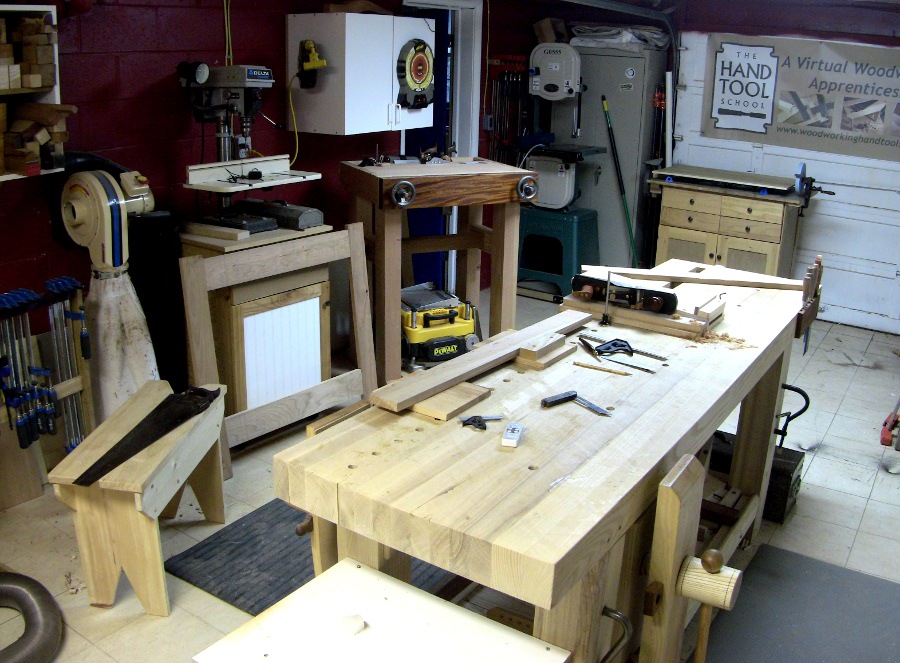
In a 250 square foot shop, there will never be huge amounts of extra space. Even the space available from the massive footprint of the table saw and jointer disappeared quickly. I immediately filled the space where the table saw went with my Joinery bench and my saw bench slotted nicely into the space where my jointer was. The key is that instead of these spaces going unused now they are vital to my workflow. The sawbench is a step away from my workbench. It is so conveniently placed that now I need to consider moving my saw til because it takes longer to go get a saw from the til than it does to make the cut. The joinery bench is in a temporary home off the wagon vise end of the bench. I have it angled in so the Moxon front vise is just a step away and it is very convenient. However, the short 32″ width makes it ideal to stick under the back window where I can get more natural light. This will be key when doing detail work like carving and inlay. With my tool cabinet completed I need to do some remodeling to make room to hang it above my saw bench and suddenly I will have a lot more available space with all the tools consolidated and within arms reach.
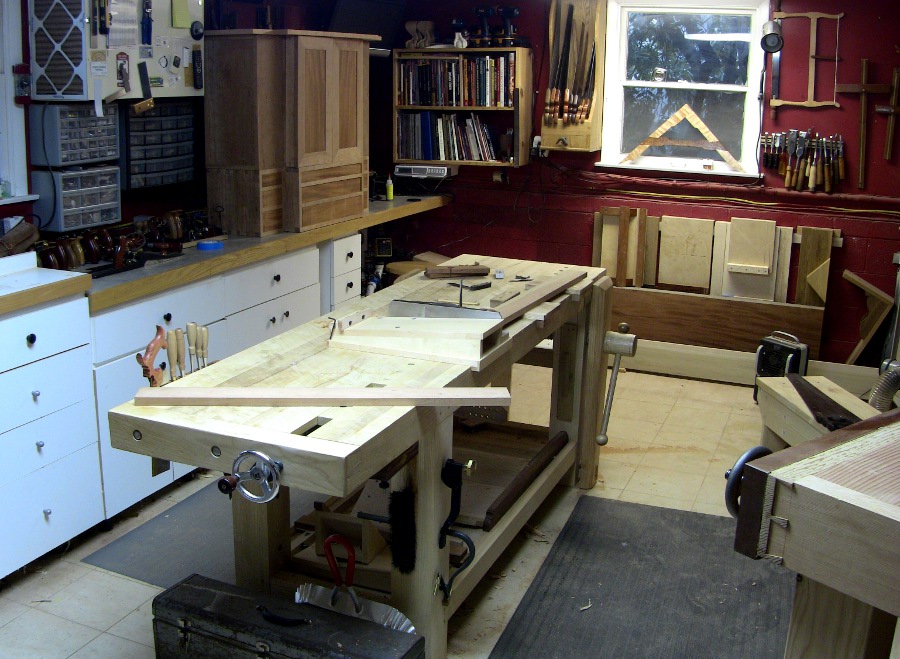
After 2 months of working this way, what I find interesting is that my “applied” space has shrunk. All of the places I work have contracted in around the Roubo workbench and it is rare that my feet ever leave the 24×48 anti fatigue mat in front of my bench. The lathe still sees a lot of use (especially at Christmas) and my bandsaw fills in when I’m feeling lazy but these tools fall outside my “sweet spot”. When I’m standing in this spot I can build anything and reach any tool. While my methods of work haven’t changed and the joy of working by hand is stronger than ever, this smaller work area feels more productive and less distracting.
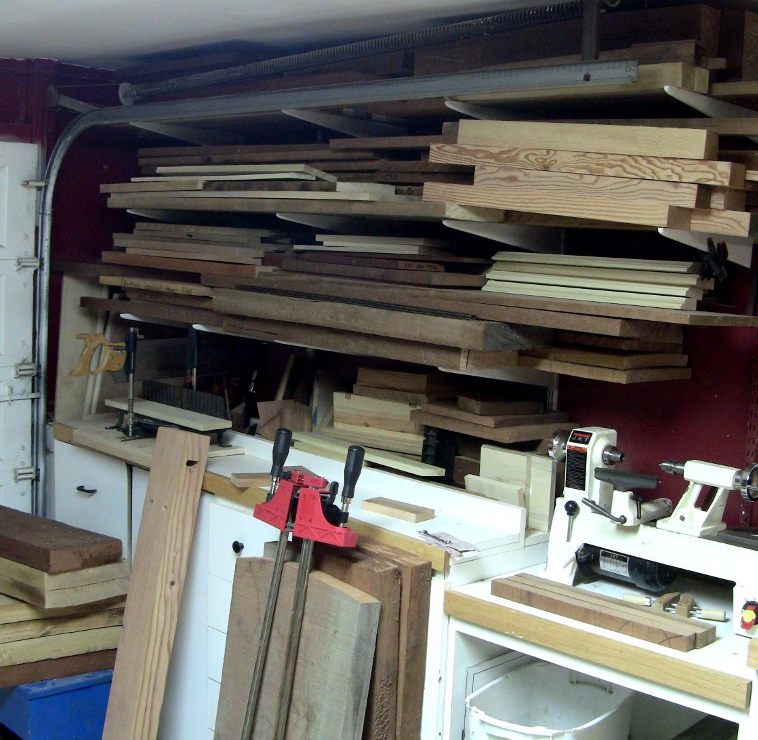
So now when I look around the shop I find that there is a lot of unused space that is full of stuff. I have base cabinets and wall cabinets that are practically empty. My lumber corner is like some kind of virus that sucks up space and never is organized. I have already begun moving my lumber stash out of the shop and into my backyard shed (more on that in a podcast) in an attempt to recapture the front corner to eventually house my planned treadle lathe (Hand Tool School Semester 5). The thing is that other than the treadle lathe, the space freed up by cleaning out and consolidating does not have a plan. My current work methods don’t require any more tools, gasp! Were I still working along the power tool path, my first inclination upon freeing space in the shop would be to fill it with a drum sander or bigger planer.
Now with life after power tools, I think a rocking chair, reading lamp and a couple of nice framed pictures sounds like it would fill the space better.
Google+ Profile


I don’t know how you get by without a moaning chair. I’m thinking of adding a second to my shop…
Well I had a couch for about a year but the dog took that over until we go t rid of it. Now I sit on my saw bench. If there is going to be a moaning chair in my shop then it will be one I have made. With Hand Tool School semester 3 starting in a week my free time seems to have evaporated.
Nice post Shannon, very interesting perspective. I’m actually wondering if there might be a correlation between shop size and the appeal of hand tools. My original shop space was just about 400 square feet, and that was about the time I acquired the vast majority of my hand tools, and probably used them the most. When I doubled the shop space (mainly to fit an 8″ jointer that’s over 6′ long) I found that I started re-investing in power tools, and now rely more heavily on them.
I’m thinking that because my power tools are all permanently set up, connected to dust collection, and just a button push away, the time savings is enormous. I realize you might be a bit of a special case given that you run the hand tool school, but on the opposite end of the spectrum it seems that guys with massive shops tend to rely even more on power tools than I do. Could be a case of the tail wagging the dog, but it made me think when you mentioned the size of your space.
I have no doubt Rob. My power tool inconvenience was because I had to “set up” each tool before use. Moving the table saw, changing blades, pluggin in, etc. Then breaking one tool down to set up another had a major role in driving me toward picking up the hand saw for that quick cut, then the medium cut, now all the cuts. Having dedicated machine space is huge for an efficient shop so when it isn’t there you move towards solution that keeps you anchored to one spot like a workbench. The museum where I do some volunteer work in the summer has a huge hand tool shop and it isn’t efficient to walk from the bench 30′ across the room to the plane shelves and back. Of course that is set up to display more than work so it is a unique case.
This is so true. As much as I love my router — the 10 minutes it takes to get everything outside (my patio is my “shop”) – and get it set up, the more I wish I had moulding planes (or profile planes…whatever they’re named), beading tools, etc. Plus, hand tools are just quieter, which extends my working time outside past noise ordinance hours.
I have actually toyed with the idea of getting rid of my table saw at times. I really only use it on operations where there really isn’t a viable alternative. And I don’t actually use my router table all that much either. I suspect I could fairly easily replace both those with hand tools or alternate power tools (I seem to use my bandsaw a lot – must be my European heritage). It’s the dimensioning tools I couldn’t do without. It’s one of my least favorite parts of woodworking, so the faster and cleaner I can do and get on to joinery, the better.
I dunno how you do it, Shannon. I mean, I think about the cuts I have to make with my table saw, and then I think about doing that with a hand saw… and then I think about how slow I already move…
There definitely is some element of practice and being able to saw to a line, but I think you will find that in most cases the time to actually saw the material isn’t that much different between power and hand. Granted my table saw wasn’t a beast so I couldn’t rush a board through it. What slows people down and frustrates them is the clean up and fixing of an errant cut after the fact. Fine work needs to be clean up off the table saw anyway right so if you saw to your line accurately the planing passes you take are no different than the piece that came off the table saw. Some dedicated practice time and a well tuned saw will get you cutting accurately in a surprisingly small amount of time.
I have done the same thing in my little 16′ x 12′ shop. I really haven’t looked back though as Rob theorized, I’m sure if I suddenly had a much larger space, I’d let power tools creep back into my life. I still have 4 main power tools – bandsaw, router/router table, and thickness planer and my Tormek.
I think that I could get rid of the bandsaw easily enough though I can be pretty tired after several long rips.
I’m actually really considering getting rid of the router and router table much through your section on moldings. I’ve already done dado’s and rabbits with only hand tools and they turned out great. I’m close to doing this one.
I haven’t used my thickness planer but may be about to dive into a roubo build and may pull it out for that then get rid of it. I remember reading that even Chris Schwarz has kept that along with a bandsaw so I’m mixed.
I’ve got a nice rhythm for sharpening that my Tormek helps with so I don’t think I’ll get rid of that.
I feel I’ve made so much progress with skills and organization over the last 3 years and just a few minor tweaks could get it so I’m not even thinking about organization in the shop.
I find that since I am enrolled in the Handtool school I now use a saw or plane more often and less of the power tools. Still learning and will probably continue to use a combination of hand and power tools. I do like not having to deal with the dust that power tools create, even with a cyclone dust collector.
I was able to flatten the first side of the 2 x 12 boards for the shelf in my Roubo by hand, although I did use the planer to finish the other side and table saw to cut the tongue and grove edge joints.